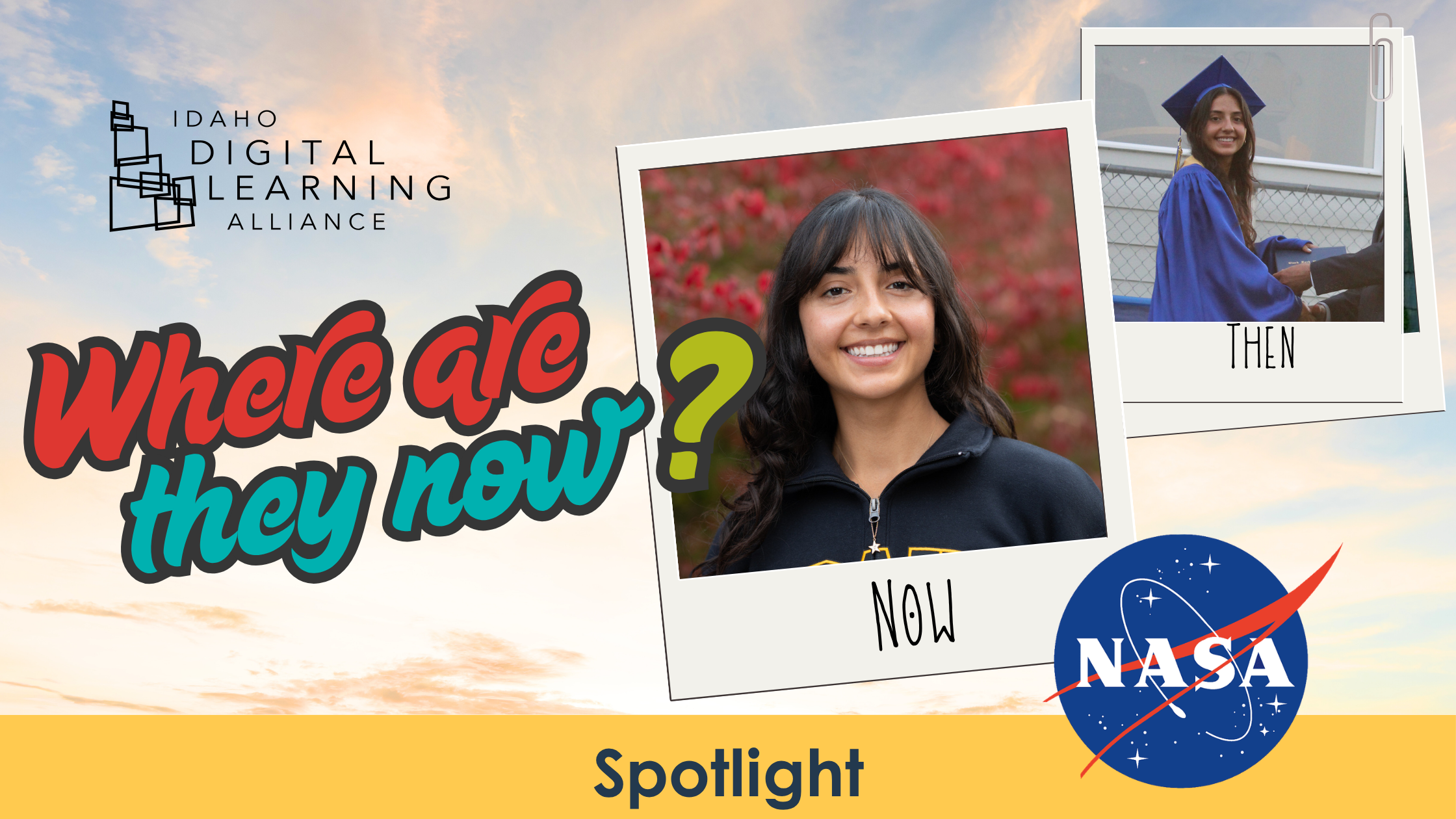
From the shores of Lake Pend Oreille to the research labs of NASA, Emily Myers has taken her love of science farther than she ever imagined. A 2023 graduate of Clark Fork Jr-Sr High School, Emily completed 22 courses through Idaho Digital Learning Alliance (IDLA) before pursuing Biological Engineering at the University of Idaho. Now, with undergraduate research and a NASA internship under her belt, she’s setting her sights on a future in biomedical engineering.
Small-Town Roots, Big Opportunities
Growing up in the Hope/Clark Fork area in Northern Idaho, Emily spent much of her time outdoors, playing sports, fishing, and skiing at Schweitzer. At Clark Fork Jr-Sr High School, she was involved in athletics, volunteering, and student leadership. However, with approximately 120 students across middle and high school, course options were limited.
IDLA helped fill those gaps, giving Emily access to subjects that weren’t offered locally. Throughout high school, she completed 22 IDLA courses, including 12 dual credit classes.
“The pursuit of knowledge!” Emily said, when asked what motivated her to take so many classes. “A lot of the subjects I was interested in weren’t offered at my school, so IDLA was the only way to take them.” The flexibility of online learning also allowed her to keep up with coursework while traveling for athletics, making it easier to pursue her academic interests alongside her extracurricular activities.
Discovering a Passion for Science
One of Emily’s most memorable IDLA courses was Medical Terminology, which introduced her to anatomy and medicine in a way she hadn’t experienced before. “I was fascinated by how learning a word’s prefix, suffix, and root let you intuitively understand complex medical terms, and along the way, I was learning anatomy and medicine too. I felt like a little doctor!” she recalled.
Although initially nervous about the course, Emily quickly gained confidence as she worked through the assignments. Her interest in science grew even stronger during her sophomore year when a skiing accident resulted in a torn ACL. Unable to participate in sports during recovery, she focused more heavily on academics and became fascinated by the science behind her own surgery and healing process.
That curiosity eventually led her toward Biological Engineering, where she could combine her interests in medicine, problem-solving, and engineering. Her participation in the Idaho Science and Aerospace Scholars (ISAS) program further expanded her interests, introducing her to opportunities in aerospace research and the possibility of interning at NASA.
From the University of Idaho to NASA
At the University of Idaho, Emily joined a tendon tissue engineering lab, gaining hands-on experience with stem cell research, cell cultures, and laboratory techniques.
After learning more about NASA internships through the Idaho Space Grant Consortium, Emily decided to apply. “I’d set a reminder months earlier for when the application opened, and when the notification popped up, I was bored in the library, so I applied that day instead of studying. Productive procrastination!” Months later, Emily received the notification that she’d been offered an internship at NASA’s Ames Research Center.
During her internship, she worked in a radiation biophysics lab studying how radiation could affect the human brain during future space missions. Using lab-grown brain cell models, her team explored the potential effects of radiation exposure on astronauts traveling to Mars.
“What stuck with me most was realizing how much research and knowledge is being uncovered in the lab and the building I worked in, and that this work has real implications for the future.” Her experience also gave her a new perspective on scientific research. “At NASA, everything I’d learned was flipped on its head, literally! An experiment that works on Earth gets so much more complicated in space with microgravity, and that’s what makes it so exciting.”
Looking Toward the Future
Emily hopes to build on her research experience by completing a one- to two-year postbaccalaureate research program after graduation, followed by a PhD in biomedical engineering. Outside of academics, she has another goal in mind: completing an Ironman 70.3 triathlon!
For students from small or rural communities who are interested in STEM but aren’t sure where to begin, Emily offers this advice: “It’s possible, so dream big! Now is the time to try every interest you have. Ask for help from your teachers, your community, and the people around you. There are more people than you know who want to see you succeed.”